Here you will find background materials and information regarding FLMA's support of the Gulf Coast Indian Confederation's attempt to obtain information about, consult, and receive repatriation of inadvertently discovered human remains currently in the custody of the Texas Department of Transportation (TxDOT) and elsewhere. At present, the most recently discovered set of remains are being physically stored at the Center for Archaeological Research of the University of Texas at San Antonio. The Confederation has requested consulting party status as lineal descendants and culturally affiliated Indian people under NAGPRA, and is working with numerous parties to help bring this situation to a mutually agreeable solution. At present, however, TxDOT is continuing its policy of treating the Confederation's request for consultation as an "open records" request instead, and continues to rebuff any attempts by the Confederation to learn what has been going on. TxDOT still has not officially disclosed exactly what it has found, despite the fact that numerous newspaper stories have brought what has been happening to light. FLMA is using its NAGPRA expertise to educate the agency and its archaeological and environmental professionals about the nuances and substance of the law.
Corpus Christi--and South Texas generally--have a long history of inadvertent discovery of Native American human remains and the looting of such sites. Click here for a brief editorial article by Confederation member Howard Feldman, which lays out much of the basis for the Confederation's case.
Patty Jo James, a student at Texas A&M-Corpus Christi has also created a student Windows Media presentation on her impressions of what has been happening. While there are some factual errors in what she has put together, it accurately depicts the moral and philosophical issues at stake.
The following newspaper articles, in pdf format, provide a general overview of the development of this case:
The "Callo del Oso" site (state trinomial designation 41NU2) is one of the most famous sites in Texas archaeology, and has been known as a Native American burial and occupation locus for over 100 years. Hundreds, perhaps thousands, of burials have been unearthed from the clay dune comprising the site over the years, some by "professional" archaeologists (using the standards and stereotypes of the time), more by avocational scholars, citizens, and young people who would find inadvertent human remains in the clay dune or on the surface while playing at or near Oso Creek as children. While the bioarchaeological "research" value of these skeletal remains is also limited, the larger issue of where these human remains currently are is obviously more important, as is the proper religious treatment of the remains and associated objects. For a variety of reasons, a full accounting, in keeping with NAGPRA, has yet to take place. This is deeply disturbing to most Native American people.
It is highly likely that artifacts and body parts from this site occupy various places of regard in the households of various Corpus Christi citizens, and probably elsewhere. We also know that at least 110 sets of human remains were uncovered by UT Austin researchers and stored at the Texas Archaeological Research Laboratory (TARL for short) in Austin in the 1930's. According to the TARL head of collections, the laboratory declared these remains to be "culturally unaffiliated" in one of its NAGPRA inventories, but did not actually consult with Indian Tribes (potentially affiliated or otherwise) prior to making this unilateral decision. This not only violates the letter and spirit of NAGPRA, it is an unfortunate tactic all too often used by "museums" whose administrators dislike NAGPRA and play games with the law's sometimes technical requirements. FLMA hopes that its public education campaign in conjunction with the Confederation leads to the "no questions asked" repatriation of these items back to Indian people for proper reburial.
University of Texas at Austin professor emeritus (and long time head of TARL) Thomas R. Hester provided a brief description of the site in his 1980 book Digging into South Texas Prehistory (ISBN 0-931722-05-5). Copies of this book are still available in most Texas libraries and inexpensively at a variety of online booksellers. Pages 78 and 79 of this book contain a TARL provided snapshot of the cemetery as it was being excavated. Please be forewarned: this picture contains a cemetery photo, including open grave pits and a close-up of a flexed burial.
Under contract to TxDOT, Coastal Archaeological Research conducted archaeological testing at the site in September and October 1996 and published the results of its research in April of 1997. An intact prehistoric human burial (a female) was found, along with an isolated human molar. It appears that these human remains are currently in the possession of the Corpus Christi Museum of Science and History, which along with TxDOT has not published a NAGPRA summary/inventory mentioning this individual. Click here to download a pdf copy of TxDOT's contracted study of the site, authored by noted South Texas archaeologist Robert A. Ricklis. This is a large file, about 11 megabytes. The report is in the public domain and can also be checked out in various libraries or purchased from TxDOT's General Services Division for about $16. FLMA thanks Dr. Ricklis for a courtesy copy of this report.
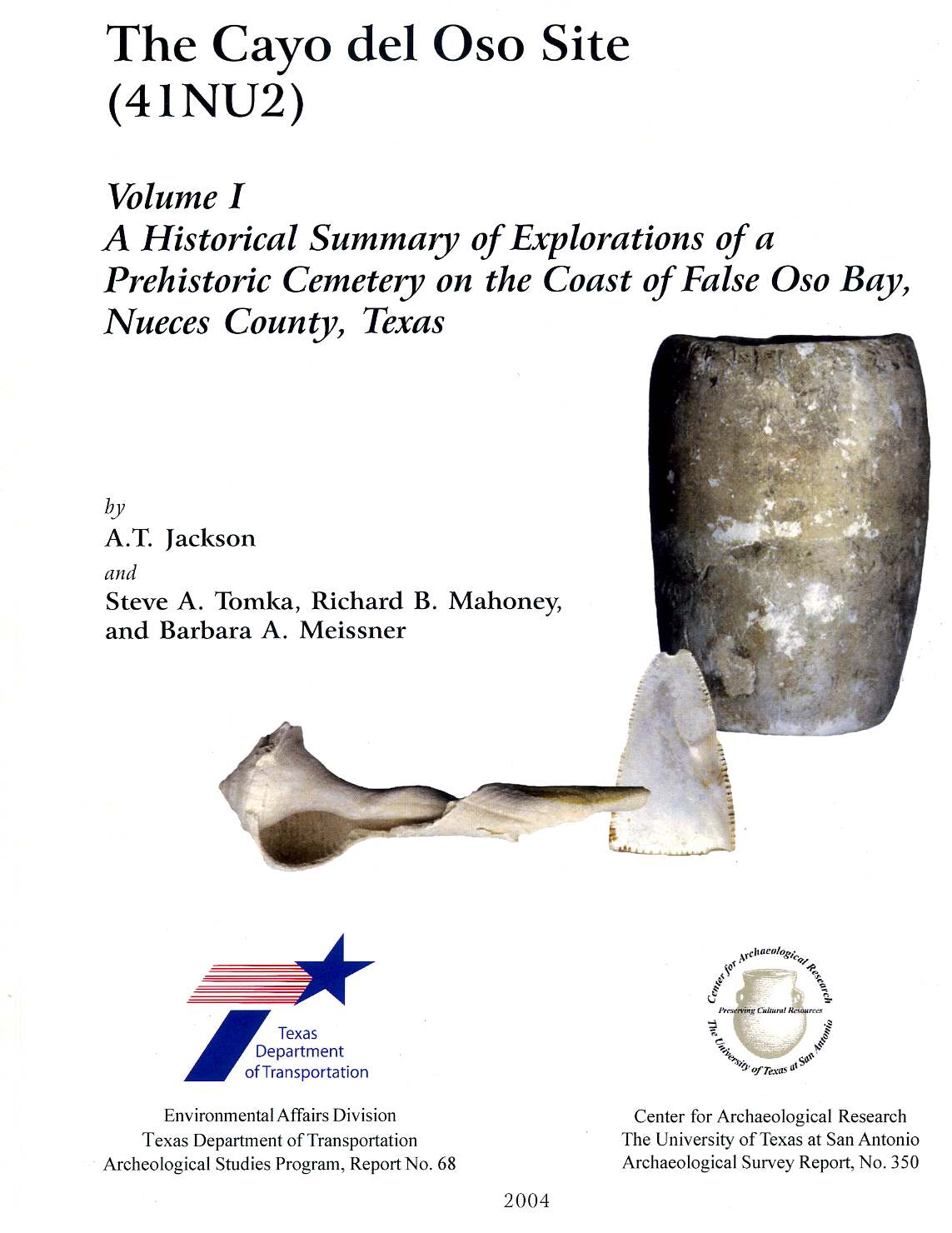
You may also wish to order a copy of the following report: The Cayo Del Oso Site (41NU2) Volume 1: A Historical Summary of Explorations of a Prehistoric Cemetery on the Coast of False Oso Bay, Nueces County, Texas. This report, published 2004, is the most comprehensive treatment of the excavation history of this archaeological site, although it does not detail the research conducted by Dr. Ricklis discussed in the preceding paragraph. The report's main value lies in its publication and description of the A.T. Jackson manuscript that reports the results of the 1933 University of Texas at Austin excavations mentioned above. The Jackson report is of interesting historical value not only in terms of its findings, but also in terms of showing how far South Texas archaeology has (and hasn't) come in terms of archaeological methodology, ethics, and research approaches. You can order the report for about fifteen bucks here (scroll all the way down to the bottom).
During the last week of October 2005, the Confederation received an official letter of denial from TxDOT. The letter was signed by the agency's cultural resources branch chief Dr. Nancy Kenmotsu and is largely based on the flawed analysis she solicited from the state attorney general's open records office. For FLMA's response to Dr. Kenmotsu, click here.
As someone once famously noted, facts can be stubborn things. For information regarding the "Lipan Apache Band of Texas, Inc." click on their official website which is here. According to the website of the Texas Comptroller, the organization which is not federally recognized as an Indian Tribe, is a Texas non profit corporation, chartered April 13, 1999.
The Gulf Coast Indian Confederation, like other organizations of the type, is also a non-profit entity, although it has chosen not to incorporate. It, at this time, does not desire or need federal money.
Lipan General Council Chairman Daniel Castro Romero Jr. also has considerable experience with NAGPRA. Regrettably, he represented himself in federal court regarding human remains uncovered in Universal City a few years ago and lost. For a copy of the Fifth Circuit court of appeals opinion, in this case (one of the few NAGPRA cases from Texas to have reached that level) click here. The legal opinion is dated July 16, 2001.
It should be pointed out that the court's interpretation of NAGPRA was largely incorrect. NAGPRA is civil and human rights legislation and is not conditioned on land ownership like other historic preservation laws. Land ownership is only an issue in "inadvertent discovery" cases, and does not apply to the museum provisions in the law. Unfortunately Mr. Romero apparently did not make this clear to the court. FLMA and the Gulf Coast Indian Confederation have been repeatedly also making this point to TxDOT.